Water treatment vs wastewater operator: which discipline should you certify in?
Quick answer
Should I become a water treatment operator or a wastewater operator?
Both are stable, recession-resistant public-utility careers with steady demand. Water treatment and distribution keep drinking water safe and tend to face more visible regulatory pressure; wastewater treatment and collection clean sewage and carry the harder process-control math. Many operators eventually certify in both. Start with wherever a plant near you is hiring, because you learn the trade on the job.
If you are deciding where to start, know first that this is rarely a permanent fork. A large share of working operators end up certified in more than one discipline, because small and mid-size utilities need people who can cover both the drinking-water and the wastewater side. But you certify in one discipline at a time, and the first one shapes your first few years, so it is worth understanding the real differences before you commit.
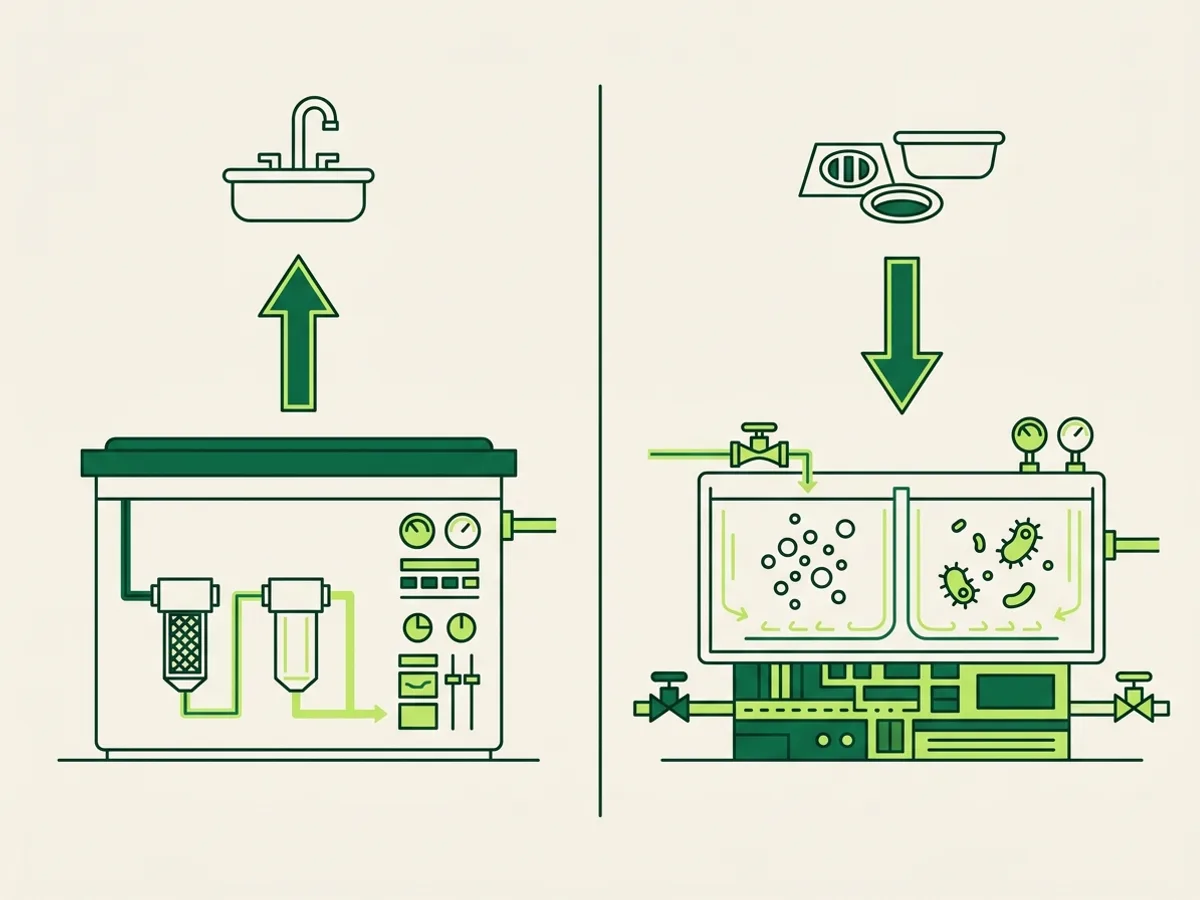
Operator certification is split into four disciplines, and states certify each separately. They pair naturally into a drinking-water side and a wastewater side.
The drinking-water side
Water treatment is the plant work: taking raw water from a river, reservoir, or well and making it safe to drink. The core processes are coagulation and flocculation, sedimentation, filtration, and disinfection. The math you live in is dosage (the pounds formula), CT disinfection to prove pathogens were inactivated, and filtration loading rates.
Water distribution is what happens after treatment: keeping finished water safe and pressurized across the pipe network, including storage tanks, pumping, main flushing, and cross-connection and backflow control. Distribution operators deal less with process chemistry and more with hydraulics, pressure, disinfection residual out in the system, and protecting water quality between the plant and the tap.
The drinking-water side carries the most visible regulatory weight, because a failure reaches the public directly and fast. Sampling, reporting, and compliance with the Safe Drinking Water Act are a constant part of the job. If you like the idea that the thing you make goes straight to people’s kitchens, this is your side.
The wastewater side
Wastewater treatment takes sewage and cleans it enough to return to a river, lake, or the ground without harming it. The heart of the job is biology: the activated-sludge process, where you keep a living population of microorganisms healthy so they consume the organic load. That is why the wastewater exam adds a whole family of process-control ratios, the food-to-microorganism (F:M) ratio, mixed liquor suspended solids (MLSS), sludge volume index (SVI), and sludge age, on top of the general water math.
Wastewater collection is the network side: keeping the sewer system, lift stations, and force mains moving flow to the plant, managing infiltration and inflow, and dealing with blockages and overflows. Like distribution, it is more hydraulics and infrastructure than process chemistry.
Wastewater work is dirtier and less visible to the public, and operators will tell you it is also where the more interesting process-control problems live. The biology never stops changing, so the job is never quite the same day to day. Many operators find the wastewater side more intellectually engaging for exactly that reason.
Which has the harder exam?
The wastewater treatment exam is generally considered the more math-heavy, because the activated-sludge ratios stack on top of all the general water math. Water distribution and wastewater collection exams lean more on hydraulics, regulations, and infrastructure and less on process chemistry. None of them is easy, and all of them share the same failure mode: the calculations, not the theory. Whichever you choose, the operator-math trainer and the math guide target that section directly.
Which pays more, and where are the jobs?
Pay is driven far more by your class or grade and your role (operator, lead, chief operator) than by which of the four disciplines you hold. A Class IV chief operator at a large plant out-earns a Class I operator regardless of water-versus-wastewater. What moves your pay is climbing the class ladder, not picking the “right” side. For a closer look at the pay and career trajectory, see is being a water operator worth it.
On jobs: both sides are hiring, and the deciding factor is usually geography. Every town has both a water system and a wastewater system, so look at what the utilities within commuting distance actually need. A small rural district might want one person who can do everything; a big-city utility might have distinct water-treatment and wastewater-treatment plants hiring separately.
How to actually choose
For most people the answer is: start with whichever certified plant near you is hiring an entry-level or operator-in-training role. You learn this trade on the job, under a certified operator, while logging the experience your state requires. The discipline of your first job is often decided by which plant said yes first, and that is fine, because the certificate you earn there is a real credential you build from.
If you do have a choice, decide on temperament:
- Choose the drinking-water side if you want the most direct public-health mission, prefer chemistry and compliance, and do not mind the regulatory spotlight.
- Choose the wastewater side if you like biology and process control, want the more varied day-to-day problem-solving, and are not put off by the less glamorous setting.
Then plan to pick up the other side later. Dual certification makes you far more employable, especially at the small and mid-size utilities that make up most of the market, and it is a common, deliberate career move rather than an accident.
Whatever you choose, your state sets the specifics, the classes, the experience minimums, and the fees for each discipline. Start with how to become an operator for the path and your state’s page for the numbers.
Sources: the four-discipline structure (water treatment, water distribution, wastewater treatment, wastewater collection) and the process content described here are the standard, public structure of United States operator certification under Safe Drinking Water Act primacy and Clean Water Act programs. Pay statements are qualitative; for current occupational wage and outlook figures see the U.S. Bureau of Labor Statistics Occupational Outlook Handbook. Authored by the Water Cert Prep editorial team. Not career or legal advice. Reviewed 2026-07-24.